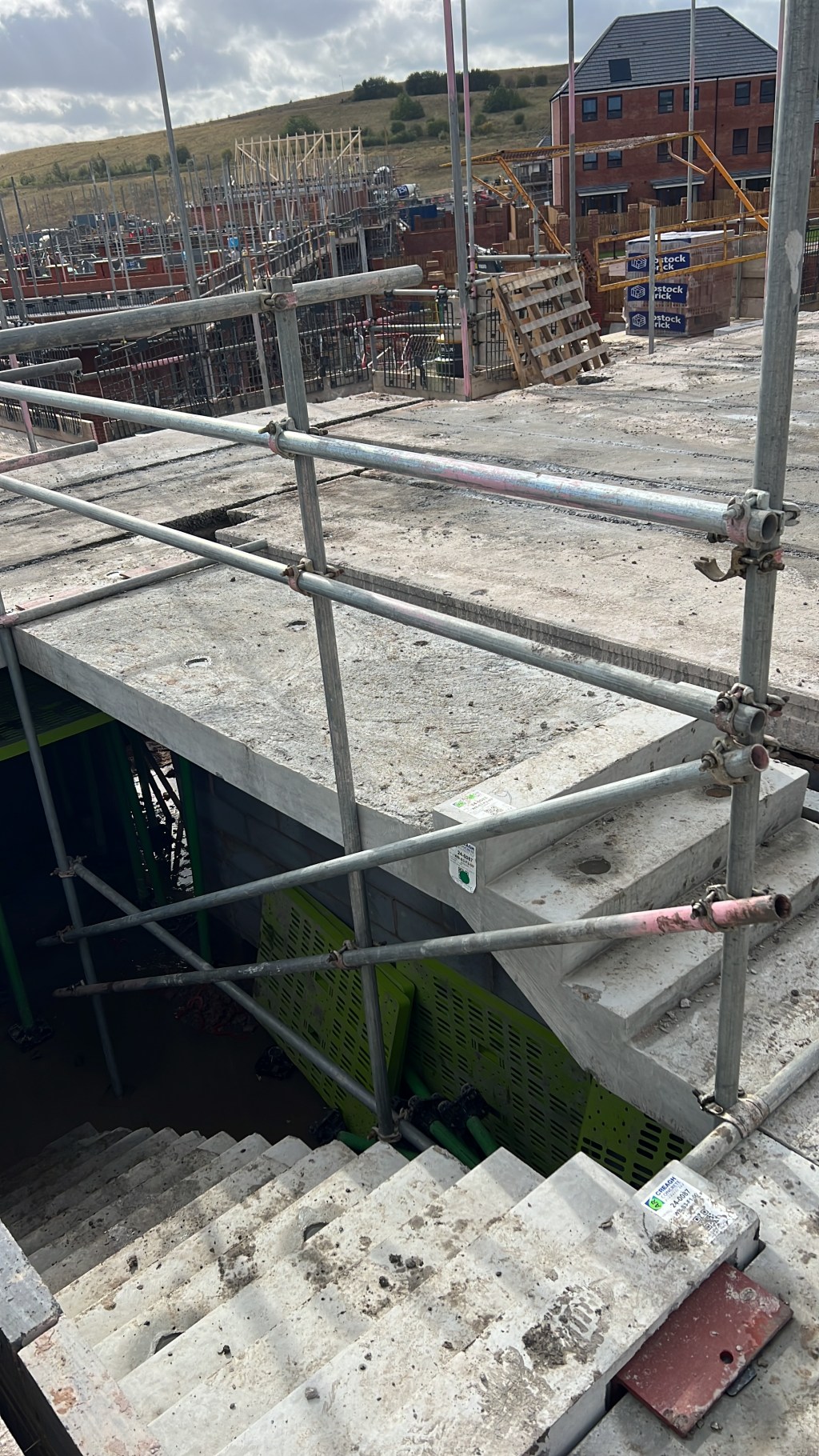
Scaffolding edge protection is a critical safety system comprising physical barriers installed along the open edges of scaffold platforms, roofs, or other elevated work areas. Its primary purpose is to prevent falls of workers and stop tools, equipment, or debris from dropping onto people below.
Core Components
A standard edge protection system typically consists of three main elements:
• Top Guardrails: A solid horizontal rail positioned at a regulated height, usually between 950 mm and 1150 mm above the platform, to provide a primary physical barrier.
• Mid-rails: One or more intermediate rails installed so that no unprotected vertical gap exceeds 470 mm, preventing workers from slipping through the middle of the frame.
• Toe Boards: Low barriers, at least 150 mm high, fitted at the base of the platform to contain materials and prevent feet from slipping over the edge.
Types of Systems
Systems are categorised based on the slope of the surface they protect, as defined by European standard EN 13374:
• Class A: For flat surfaces and slopes up to 10 degrees.
• Class B: For slopes up to 30 degrees.
• Class C: For steeply sloping surfaces up to 60 degrees.
Common Formats
• Mesh Barrier Systems: Combine guardrails, toe boards, and mesh infill into a single, high-containment product.
• Netting: Often added to provide debris containment and protect the public from dust.
• Protector Tubes: High-visibility foam tubes wrapped around poles at ground level to provide impact protection for pedestrians.
• Counterweight Systems:Freestanding units for flat roofs that use weights to stay secure without drilling into the structure.
In the UK, installing edge protection is a legal requirement under the Work at Height Regulations 2005 (https://www.hse.gov.uk/work-at-height/index.htm) wherever there is a risk of a fall likely to cause injury, particularly at heights of 2 metres or more.

